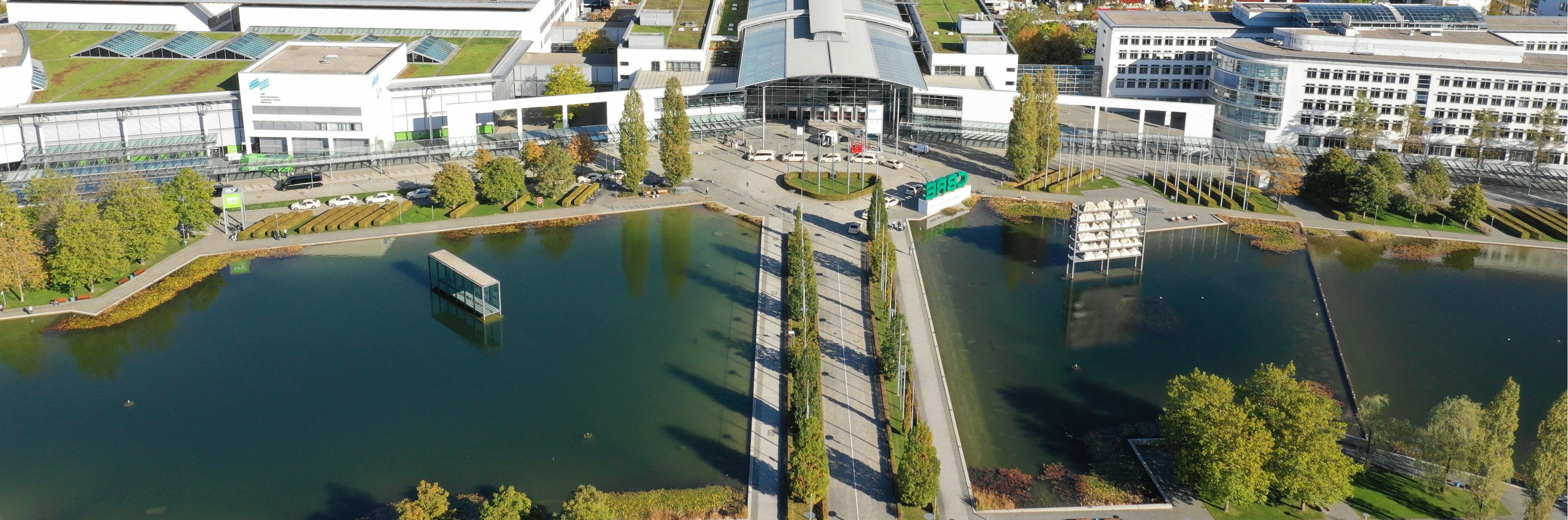
Understanding the Munich trade fair grounds: Well-structured, well-planned, well-positioned
The Munich trade fair grounds rank among Europe's most significant exhibition venues. Leading international trade fairs such as BAU, bauma, and IAA Mobility attract an audience that is discerning, international, and exceptionally well-prepared. Exhibitors here face professionals who visit numerous stands daily and know exactly how to assess quality.
Like any exhibition venue, Munich has its own characteristics. These can be viewed as obstacles or as parameters to work with strategically. The difference lies in knowing the details.
Think big (because the venue certainly does)
Long distances, planned routes: The Munich trade fair grounds span approximately 200,000 square metres of covered exhibition space across eighteen halls. The distances between halls are considerable, but the venue is designed precisely for this scale. Public transport connections work reliably, exhibitors have access to an internal shuttle service, and parking is well organised. First-time visitors find their bearings faster than expected because the layout follows a clear logic. However, this size has a direct impact on visitor behaviour: Trade visitors aiming to cover multiple stops in a single day plan their routes carefully, often in advance using site maps, exhibitor directories, and pre-arranged appointments. Walk-in traffic is therefore less common than at more compact venues. This is not unusual; it is simply the logical consequence of the venue's scale.
Central location, higher footfall: The central halls around the main entrance axis naturally see higher visitor numbers than those on the perimeter. A position at the far end of the main axis does not mean being out of sight, but it does require more proactive measures to attract attention than a spot near the entrance. This starts with the stand's visual impact from a distance within the hall and extends to how visitors are guided there. The flow of foot traffic within a hall is an underestimated variable. Depending on where the main entrance is located, which companies are in the immediate vicinity, and how the aisles are laid out, visitor behaviour changes considerably.
Early appointments, busy stands: What the venue's layout lacks in passive footfall can be offset through proactive pre-event communication. Scheduling appointments with relevant contacts before the fair begins is not optional in Munich; it is an essential part of any exhibition strategy.
Relying solely on spontaneous stand visits as the basis for trade fair success leaves too much to chance. This applies to other venues as well, but in Munich it carries more weight because distances are longer and visitors' schedules are more tightly packed.
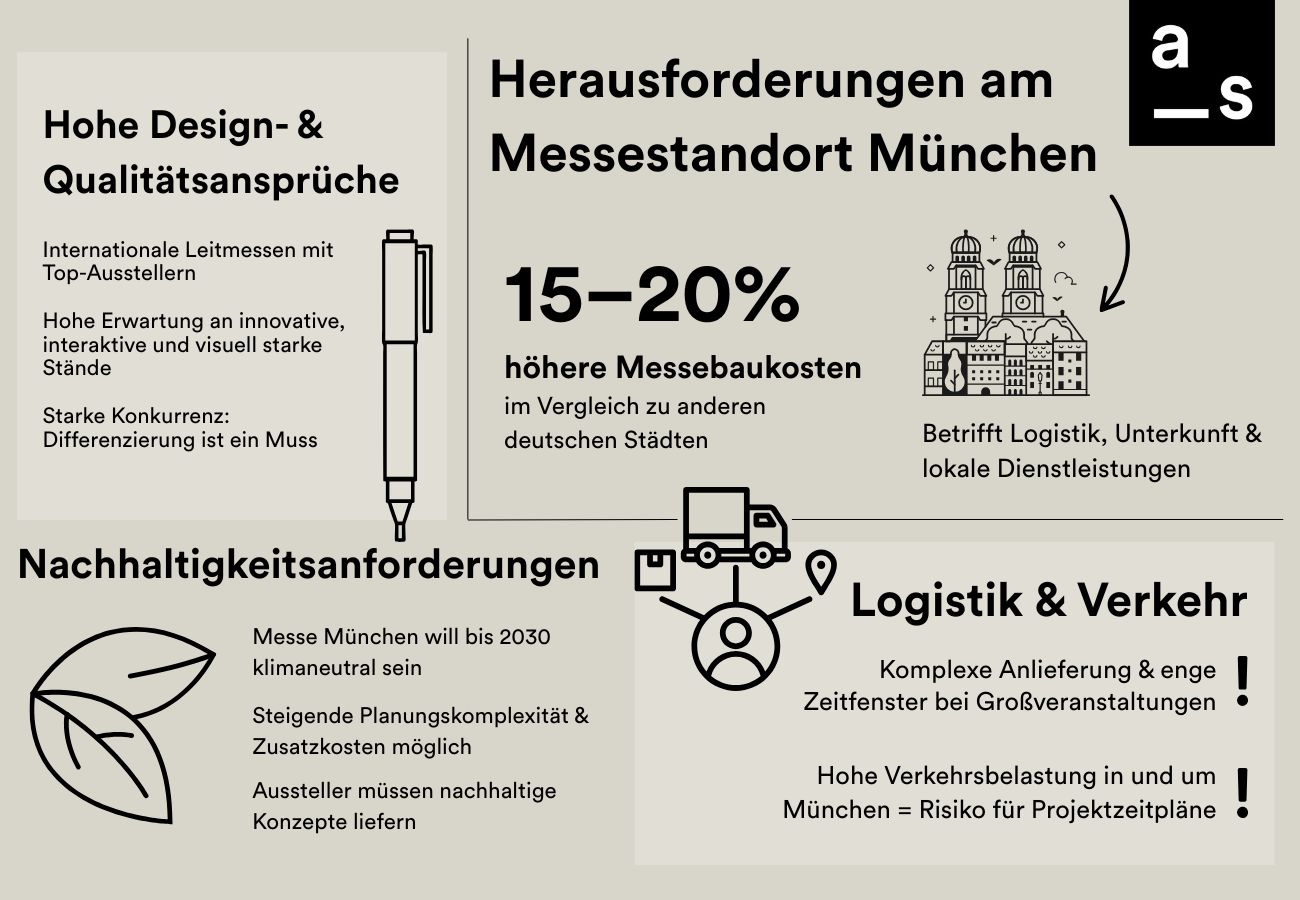
Green requirements: In Munich, sustainability is no longer optional
Messe München pursues ambitious sustainability goals and has defined a clear climate target with Net Zero 2050. This direction increasingly shapes expectations for exhibitors as well: Material choices, waste management concepts, and resource efficiency are gaining prominence. This is neither surprising nor unreasonable; it is the logical consequence of the fact that temporary architecture on this scale moves considerable resources and carries corresponding responsibility.
For exhibitors, this means sustainability is no longer an optional quality feature but a planning parameter that should be considered from the outset. Incorporating circular materials, reusability, and resource-efficient construction only at the end of the process typically costs more and achieves less than an approach that addresses these questions from the start.

The people behind the venue
Those who truly know the Munich trade fair grounds rarely mean the halls themselves, but rather the people who work within them. Behind every seamless build-up is a network that has grown over years: The hall manager who flags a change early, the service providers you have worked with for a decade who can still find a solution at short notice, or the on-site technical coordination team who know exactly where there is flexibility and where there is not. These relationships cannot be summarised in a briefing or read from a handbook.
They are built through presence, reliability, and the willingness to remain dependable even when things get stressful.
For companies that only exhibit a few times a year, building such a network is not easy. An experienced exhibition stand partner can help here, as these long-standing connections are part of their daily work. Clients benefit from this before, during, and after the fair, whether in planned processes or unexpected situations.
Customised rebuilds: Why modularity dramatically shortens the to-do list
The term modular exhibition stand construction describes two fundamentally different approaches that differ considerably in practice. The classic system-based method works with standardised, prefabricated components. This enables fast assembly and predictable costs, but requires the brand to conform to a predetermined grid.
Our approach works differently. If an exhibition stand is to be used over several years and across different formats, we factor this in from the start. The construction follows the brand identity, not a kit of parts. As many elements as possible are designed and built to adapt flexibly to different stand sizes and hall geometries without sacrificing design consistency. The first build is therefore often more involved than a one-off stand. But every subsequent appearance benefits from the decisions built into the original concept: In terms of design, logistics, and budget. In Munich, where transport costs and local services have a noticeable impact on the budget, this difference is particularly relevant. A system that is truly reusable because it was developed for your own brand rather than for generic use pays off faster here than elsewhere.
Munich is an outstanding trade fair location. It offers reach, a qualified international audience, and the infrastructure for appearances of any scale. It is not more complicated than other venues, simply specific. For years, we have been delivering exhibition stands in Munich. We know the halls, the processes, and the details that make the difference. This knowledge informs every project we undertake here. For our clients, this means less friction, more flexibility, and a partner who does not need to get acquainted with Munich first.
 Exhibition stands |
Always on the move: Innovative exhibition stand construction for the logistics industry
Logistics is invisible precision. Fleets, warehouses, routes and data streams move goods around the globe. But how do you showcase on just a few square metres what's happening across continents in real time?
Read More Exhibition stands |
Megawatts meet square metres: Exhibition stands for renewable energy
Renewable energy often works invisibly – but at trade fairs, its true power comes to light: Technologies that usually operate behind the scenes become surprisingly tangible and are told in compelling ways.
Read More Exhibition stands |
When science meets the stage: Exhibition design for pharma, biotech, and MedTech
When high-tech pharma meets exhibition design, spaces emerge that make the invisible visible. Where strictly regulated processes apply, a world of surprisingly immersive innovation unfolds.
Read More