Sustainable exhibition stand construction:
A statement today, the standard tomorrow
Sustainability is the buzzword at every trade fair. Yet conventional exhibition stand construction often remains stuck in old patterns: Produce, use, discard. We want to leave this convenient throwaway mentality behind and focus on transparency and measurable change instead.
An honest realisation guides us: There is no such thing as a fully sustainable exhibition stand. However, every project can become more environmentally conscious, step by step: Through smart material choices, innovative concepts, and genuine responsibility.
IBC Solar: A case in point
Sustainability without compromise
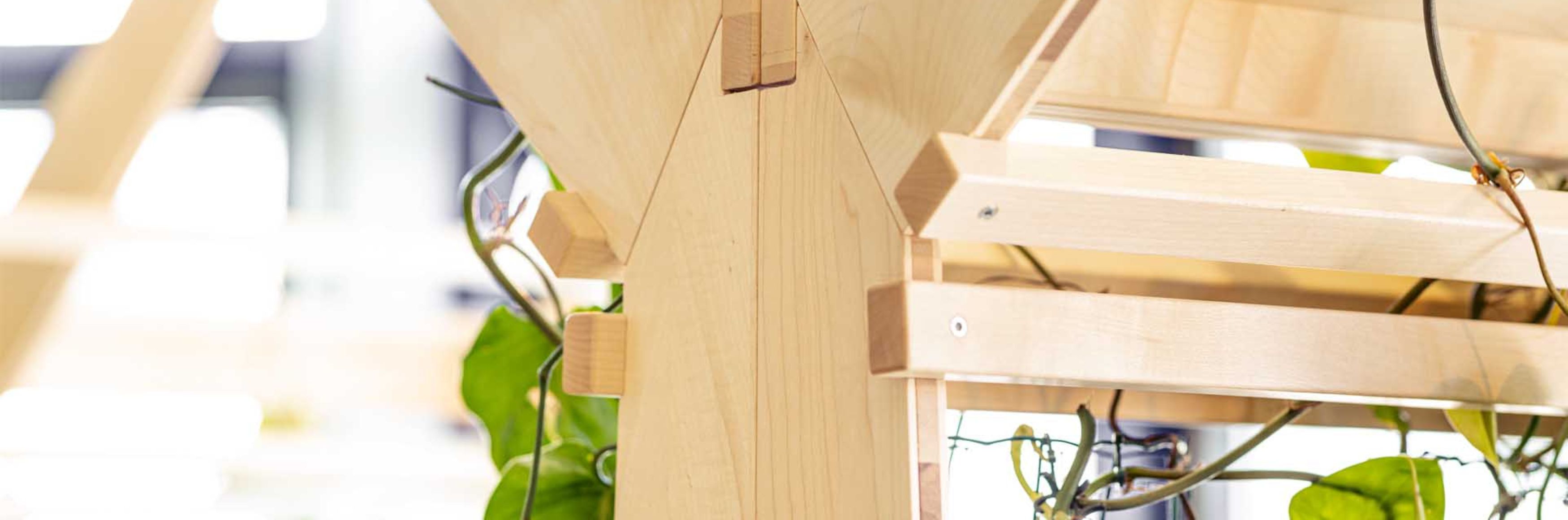
Sustainability is not born from good intentions, but from concrete decisions – even when they deviate from the norm. For the IBC Solar trade fair presence, we eliminated the floor covering entirely, saving 7,000 kg of material. By consistently using mono-material construction, 98% of all components could be returned directly to biological or technical cycles. The remaining 2% found a new home – for example, as a fence in the bee garden at Montessori School Dachau.
Our Cradle to Cradle (C2C) approach is based on the design principles of Prof. Dr. Michael Braungart and EPEA Hamburg: all components are conceived in such a way that they can be returned to either biological or technical cycles—without loss of quality and without downcycling.
Unlike conventional recycling, C2C thinks in genuine cycles. Organic materials such as untreated wood do not end up back in nature after use—they become nutrients for new biological processes. Materials such as aluminum or textiles remain in the technical cycle and are processed in a highly sorted, “like-for-like” way into new, equivalent products.
We already think about the end at the conception stage. The central question is always: How can we achieve the desired architecture and the right sense of space with the least possible material—and in the most sort-pure way? The less material we use, the less waste we generate. The more precisely sorted the components are, the easier it is to bring everything back into the cycle.
This considered approach is what distinguishes Cradle to Cradle from conventional exhibition construction that follows the “Cradle to Grave” principle—produce, use, dispose.
Why sustainable exhibition construction is more than a green choice
Sustainability ambitions in exhibition stand construction are often perceived as a constraint: less material, less creative freedom, more compromises. But the logic reverses the moment you treat sustainability as a design principle rather than an afterthought. Whether through material selection, construction methods, or a deliberate approach to resources across a stand's entire lifecycle — sustainable concepts demand more precise decisions. And that precision pays off: creatively, economically, and in how you are perceived by clients, partners, and procurement panels.

Costs & calculation
Amortisation from the second use onwards
No repeated briefings, no redundant planning efforts
More precise budget planning through familiar cost structures

Profile & positioning
Visible sustainability commitment towards clients and partners
High-quality aesthetics without design compromises
Competitive advantage in tenders with sustainability criteria

Responsibility & regulation
Measurably smaller ecological footprint
Early compliance with stricter environmental regulations
Certifications and documentation upon request
cause the container isn’t a strategy:
Sustainability starts with thinking about the end
Anyone who genuinely wants to build a sustainable exhibition stand needs to factor that in from the very first sketch — not only at teardown. What can ultimately be recycled, reused, or returned is not a question of goodwill, but of the right planning. Circular flows, material selection, logistics: All of this is decided long before the first nail is driven.
Planned with sustainability in mind
The starting point is not the design — it is the conversation. We clarify what goals the appearance is meant to achieve, at which trade fairs and how frequently the stand will be used, and what should happen to it afterwards. Whether it gets reused, adapted, or cleanly returned to the material cycle is not a question that arises at the end — it determines from the outset how we plan, what we build in, and what we deliberately leave out. Thinking this through early leads not only to better environmental decisions, but in most cases to more economical ones as well. A stand designed for reuse from the start costs significantly less at its second outing than one that needs to be rethought from scratch.
Chosen deliberately
Material selection is shaped by aesthetics and function — but not by those alone. Equally important is what happens to the materials after teardown. That is why we work with FSC-certified timber, aluminium and steel from secondary sources, and single-material textiles: Materials that do not end up in a skip bin, but re-enter biological or technical cycles. Where it makes sense, we also plan modularly, so that individual elements can be reused or adapted for the next appearance.
Communicated honestly
Printed brochures and flyers serve their purpose — for three days. What happens to them after that is well known. Displays, touchscreens, and media walls replace this single-use communication with content that stays current, weighs less, and can be adapted from one appearance to the next. The devices used are either rented or shared across projects, keeping the logistical footprint lean as well. There is another advantage: Content can be updated at short notice without a single sheet of paper needing to be reprinted. Communication that adapts is not only more flexible — it is resource-conscious by design.
Measured transparently
Sustainability can be documented after the fact — but it can only be influenced beforehand. That is why we establish return systems, clean material separation, and ecological footprint tracking during the planning phase. What is built into the process from the start can not only be verified at the end, but communicated with credibility. That is not a detail — it is the defining difference between a measure and a mindset. Figures that can be traced back to real planning decisions are more convincing than any retrospective reporting.


Powered by principle
Every exhibition stand we build carries a story that begins long before its big debut — in our production facility, where the real energy decisions are made.
Our production runs on electricity from a photovoltaic system that generates more than we consume. Solar energy delivers its greatest benefit when used directly at the source: Every kilometre of transmission means physical and ecological loss. For heat, we draw on the waste heat of a nearby biogas plant. Compared to fossil fuels, biogas has a decisive advantage: When burned, it only releases the CO₂ that the biomass originally absorbed from the atmosphere. The cycle is complete.
Lower emissions in production mean a better overall footprint — and a measurable difference for every project our clients realise with us.

An exhibition stand that is thought through from start to finish delivers more than a strong appearance. It consumes less, leaves less behind, and works beyond a single use – because it was planned that way. This is no coincidence, but the result of an approach that sees responsibility not as a limitation, but as a standard.