Sustainable exhibition stand materials: From certification to construction decisions
Most exhibition stands have a structural sustainability problem. They take months to plan and produce, stand for two to five days, and then often end up in a skip. In Germany alone, trade fairs generate several thousand tonnes of waste each year. This is not a footnote but a systemic issue in an industry that represents brands externally while often practising the opposite of their values internally.
For a long time, this was simply the industry norm, and no one seriously questioned it. Today, however, in an environment where sustainability messaging is everywhere, the gap between what brands say and what actually happens at the trade fair can raise questions. Not necessarily loud ones, but noticeable.
Reuse, repairability, circularity: Principle before material
The most common mistake in the sustainability debate around exhibition construction is viewing material choices in isolation. A stand made from FSC-certified wood that still gets discarded after the trade fair is not a sustainable stand. Sustainability does not come from selecting a single material but from a concept that embeds reuse, repairability and circularity from the outset.
This means: Before the first material question is even asked, construction principles must be in place. Are components screwed rather than glued so they can be separated by type? Are surfaces chosen to allow refinishing rather than replacement? Is the system modular enough to be reused in a different configuration at the next trade fair? Only on this foundation does material selection reach its full potential.

Wood: A classic, but not automatically sustainable
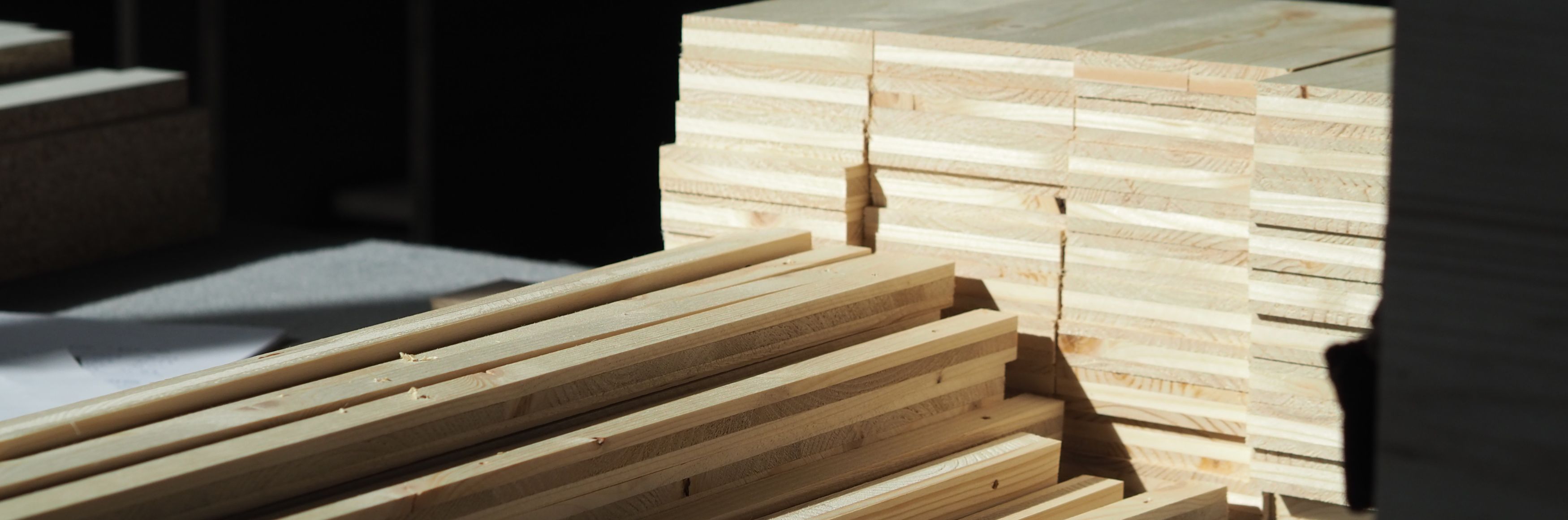
Wood is the most widely used material in exhibition construction, and for good reason: It is versatile in design, manageable in craft, and ecologically sound when responsibly sourced. FSC or PEFC-certified wood guarantees responsible forestry throughout the supply chain, while recycled wood-based materials such as OSB or MDF made from reclaimed wood further reduce primary resource consumption. These materials have long come into their own aesthetically: Their industrial look is now used deliberately, not disguised.
The crucial question, however, is not one of origin but of processing. A wooden stand fully bonded with PU adhesive cannot be separated by type at the end and ends up as composite waste, regardless of whether the wood was certified.
The same applies to laminated films that damage the substrate when removed, or coatings that make surface refinishing impossible.
Wood is structurally sustainable when it is assembled in a way that allows it to begin a second life after its first: Screw connections instead of glue so components can be separated without damage, fittings that remain accessible without dismantling the entire element, and surfaces that can be sanded down and refinished. These decisions are not made at the point of purchase but at the drawing board and in the workshop, and they require an understanding of how a component is not only built but also taken apart again.
Plastics: A nuanced view, not blanket avoidance
Plastics have a difficult standing in the sustainability debate, rightly so when used once and discarded. At the same time, in exhibition construction, weight, transport volume and safety requirements often point towards materials that would be viewed critically in other contexts. Those who rule out plastics entirely do not automatically arrive at better solutions but often end up with heavier constructions, more transport effort or material combinations that are harder to separate in the end.
What matters, therefore, is less the material label than the system behind it: Can the component be used across multiple events, and can it ultimately be channelled into a defined take-back or recycling pathway?
Recycled PET, recovered from used bottles, is suitable for displays, partition walls and translucent elements, and requires significantly less energy to produce than virgin material. Its strength lies where lightness and surface impact are needed, while the construction should be planned so that panels or modules are mechanically fixed rather than glued and can be replaced when necessary.
Acrylic glass (PMMA) remains an important exhibition material despite its plastic nature, because it delivers transparency and precision that are hard to achieve otherwise. In this context, sustainability comes not from avoidance but from recoverability: When offcuts are dimensioned for reuse and collection as well as separation by type are planned from the start, PMMA can re-enter the cycle through chemical recycling without loss of quality.


Metal and textile: Often underestimated in the sustainability debate
Aluminium is one of the most recyclable materials available: Reprocessing uses up to 95 per cent less energy than primary production, with no loss in quality. In exhibition construction, it is used for frame structures, profiles and connectors, and this is precisely where it delivers its ecological advantage as a durable, reusable structural element that improves its environmental footprint with every subsequent use.
Steel with a high recycled content works on the same principle. Modular steel systems used in varying configurations across different trade fair appearances are among the most compelling solutions, both economically and ecologically, because they spread investment and resource use over several years of events rather than concentrating them on a single appearance. This requires well-considered storage between uses: Dry, organised and documented so that components can be redeployed without effort for the next project.
Textile elements are among the most frequently overlooked material groups in exhibition construction. Fabric coverings, room dividers, ceiling sails or large-format print carriers bind considerable amounts of material yet are rarely treated with the same care as wood or metal. Here too, the crucial question is not the material alone but the path it takes after use: Trevira CS, for example, can be processed into insulation or acoustic material through a take-back programme without requiring any compromise on design or safety, and similar concepts now exist for other fabric types.
At the same time, it is worth reconsidering how textile elements are constructed. Fabrics that are glued or bonded to inseparable substrates lose their circularity regardless of any take-back system, which is why mechanical fastenings, hook-and-loop systems or tensioning frames are a prerequisite for textiles to be used sustainably in exhibition construction.
The most sustainable material is the one that is never used
Before material decisions are made, a prior question is worth asking: What does this stand actually need? Reduction is the most effective lever in sustainable exhibition construction, because any material not used does not need to be produced, transported, assembled or disposed of. This sounds obvious yet is rarely pursued consistently in practice, because exhibition stands are traditionally judged by presence and abundance.
A floor covering that is omitted because the architecture integrates services and cables in another way is not a design compromise but a construction decision. A ceiling structure that forgoes unnecessary cladding because the framework itself carries the design saves material without losing impact. Reduction in this context does not mean sacrificing quality but precision in design: Using only what truly serves a function, and solving that function so well that no additional material is needed to compensate.
Sustainable exhibition construction does not come from selecting a single material but from decisions made early in the process: In the construction, in the choice of materials, in how what remains after the trade fair is handled. Those who consider these questions from the start create stands that not only make a convincing impression but also make economic and ecological sense beyond a single use.
 Interior design |
Production
Interior design |
Production
Furniture that supports your workflow: Custom manufacturing in commercial interior design
Commercial spaces don't function as neutral shells – they're effective working tools. Furniture that only approximates the right fit creates friction that shows up in daily operations.
Read More In and around Munich |
Exhibition stands
In and around Munich |
Exhibition stands
Understanding the Munich trade fair grounds: Well-structured, well-planned, well-positioned
Munich ranks among Europe's most important trade fair destinations. The grounds are well-structured, the infrastructure carefully planned, and those who make the right moves early can achieve a great deal here.
Read More Industries |
Exhibition stands
Industries |
Exhibition stands
Megawatts meet square metres: Exhibition stands for renewable energy
Renewable energy often works invisibly – but at trade fairs, its true power comes to light: Technologies that usually operate behind the scenes become surprisingly tangible and are told in compelling ways.
Read More